Fermentation tank
2019/2/25

Detailed introduction
Fermentation is a reaction process in which specialized metabolites are produced and accumulated in large quantities through the growth, culture and chemical changes of microorganisms (or animal and plant cells). Therefore, the fermentation tank is a tank that provides occasions and conditions for the microbial fermentation process to complete. According to the different fermentation products or strains or forms, the common fermentation tanks are mechanical ventilated fermentation tank, anaerobic fermentation tank, solid fermentation tank, liquid fermentation tank, full-automatic fermentation tank, stainless steel fermentation tank, strain fermentation tank, small fermentation tank, beer fermentation tank, wine fermentation tank, edible fungi fermentation tank, double fermentation tank and triple fermentation tank. And so on. Fermentation tank has the functions of heating, cooling, sterilization and constant temperature. It can provide a suitable fermentation environment for the growth of microorganisms, that is, suitable temperature, pressure and nutrition. The medium in the fermentation tank provides the necessary carbon, nitrogen, oxygen, growth factors and water for the growth of microorganisms. Fermentation tank is mainly used to cultivate various bacteria and ferment various fermented products. Fermentation tank has the functions of automatic temperature control, automatic pH regulation, automatic data recording and automatic feeding, which greatly simplifies the operation and reduces the chance of infection. It is the main bioreactor of modern fermentation equipment.
发酵罐成品图
II. Use of Fermentation Tanks
The structure of fermenter used for anaerobic fermentation (e.g. production of alcohol and solvent) can be simpler. Fermentation tanks for aerobic fermentation (e.g. production of antibiotics, amino acids, organic acids, vitamins, etc.) are usually equipped with mechanical agitator, bubbling fermenter and airlift fermenter because of the need to continuously feed a large amount of sterile air into the tank and to consider the utilization rate of air. The fermentation process of dairy products and alcoholic drinks is a aseptic and non-polluting process. The fermentation tank adopts aseptic system to avoid and prevent microbial contamination in the air, greatly prolong the shelf life of products and product purity. The tank body is specially designed and installed with aseptic breathing stomata or aseptic positive pressure fermentation system. The tank body is equipped with a Milo plate or a labyrinth jacket, which can be heated or cooled through a heating or cooling medium for cyclic heating or cooling. The capacity of fermentation tank varies from 300 to 15000L. Fermentation tanks can be divided into laboratory small fermentation tanks, pilot production fermentation tanks, large fermentation tanks and so on. Fermentation tanks are widely used in dairy products, beverages, biotechnology, pharmaceuticals, fine chemicals and other industries. The tanks are equipped with sandwiches, insulation layer, heating, cooling and heat preservation. The tank body and the top and bottom fillers (or cones) are processed by spinning R angle. The inner wall of the tank is polished by mirror without any sanitary dead angle. The fully enclosed design ensures that the materials are mixed and fermented in a pollution-free state at all times. The equipment is equipped with air breathing holes, CIP cleaning nozzles, manholes and other devices. Classification of fermentation tanks: According to the equipment of fermentation tanks, fermentation tanks are divided into mechanical agitation and ventilation fermentation tanks and non-mechanical agitation and ventilation fermentation tanks; according to the needs of microbial growth and metabolism, they are divided into aerobic fermentation tanks and anaerobic fermentation irrigation. Fermentation tank is a kind of equipment for mechanical stirring and fermentation of materials. The equipment adopts internal circulation mode, disperses and breaks bubbles with agitator. It has high dissolved oxygen rate and good mixing effect. The tank body adopts SUS304 or 316L imported stainless steel, and the tank is equipped with automatic spray cleaning machine head to ensure that the production process meets GMP requirements.
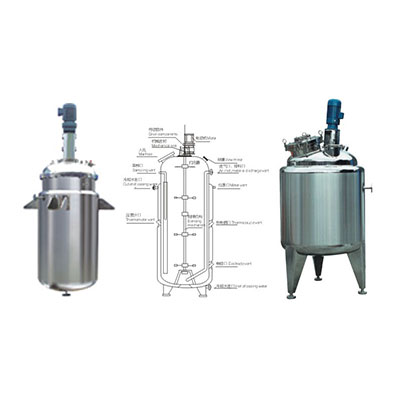
Fermentation Tank Seed Tank
Composition and Structure of Fermentation Tank
(1) tank
The tank body of fermentation tank is welded by cylinder body and elliptic or dish head, and the head and cylinder body of small fermentation tank are connected by flange. The top of the tank is equipped with visual mirrors and light mirrors to facilitate the observation of fermentation state in the tank. The nozzles on the top of the fermenter are: feeding pipe, feeding pipe, exhaust pipe, inoculation pipe and pressure gauge nozzle. The nozzles on the tank body include cooling water inlet and outlet pipes, air inlet pipes, sampling pipes, thermometer pipes and interface of measuring and controlling instruments.
(2) Size Ratio of Tank
The size of each part of the tank has a certain proportion. Fermentation tanks are generally slender due to the special needs of fermentation. The ratio of height to diameter is generally about 1.7-2.5.
(3) agitator
Fermentation tanks are usually equipped with two groups of agitators. The spacing between the two groups of agitators is about three times the diameter of the agitator. For large fermentor and high HL liquid depth, three or more groups of agitators can be installed. The bottom group of agitators is usually close to the outlet of the air duct. The distance C from the bottom of the tank is generally equal to the diameter Di of the agitator, but it should not be less than 0.8Di. Otherwise, the circulation of the liquid will be affected.
Axial agitator: blade type, propeller type
Disc turbine: straight blade, curved blade and arrow blade
(4) baffle
The function of baffle is to change the direction of liquid flow, from radial flow to axial flow, to make the liquid turn sharply and increase dissolved oxygen.
Full baffle condition: refers to adding the accessories in the tank at a certain speed while the shaft power remains unchanged. The following requirements must be met in order to meet the full baffle conditions:
(5) defoaming device
The function of the defoaming device is to break the foam. The common forms of defoamer are zigzag, comb and orifice. The aperture of orifice plate type is about 10-20 mm. The length of defoamer is about 0.65 times the diameter of tank.
(6) coupling
The stirring shaft of large fermentation tank is long and usually divided into two or three sections. The stirring shaft is rigidly connected with the upper and lower stirring shaft by coupling. The commonly used couplings are drum-shaped and clamp-shell-shaped. Small fermenter can use flange to connect stirring shaft, the connection of shaft should be vertical, the center line is right.
(7) bearing
In order to reduce vibration, medium-sized fermentation tanks are usually equipped with bottom bearings, while large-scale fermentation tanks are equipped with intermediate bearings, the horizontal position of bottom bearings and intermediate bearings should be properly adjusted. The inner bearing of tank can not be lubricated with oil. The plastic bearing bush (such as PTFE) with liquid lubrication should be used. The clearance between the bearing bush and the shaft is usually 0.4-0.7% of the diameter of the shaft. In order to prevent Journal wear, a sleeve can be added to the shaft in contact with the bearing.
(8) Transmission
The test tank is equipped with stepless speed change device. The commonly used speed-changing device in fermentation tank is triangular belt drive and cylindrical or spiral bevel gear speed-reducing device. Among them, triangular belt speed-changing device is more convenient.
(9) shaft seal
The function of the shaft seal is to seal the gap between the top or bottom of the tank and the shaft to prevent leakage and contamination of bacteria. There are two kinds of commonly used shaft seals: packing box and end seal.
The packing box seal is composed of packing box, packing bottom bushing, packing gland and pressing bolt, so that the rotating shaft can be sealed.
The advantages of packing box seal are simple structure. The main shortcomings are: many dead corners, it is difficult to sterilize completely, easy to leak and infect bacteria; serious wear of the shaft; high friction power consumption after packing compaction; short life, frequent maintenance, and long working hours.
(2) End-type shaft seal is also called mechanical shaft seal. Sealing effect is achieved by the pressure of elastic elements (springs, bellows, etc.) to make the smooth surface of the moving and static rings perpendicular to the axis closely adhere to each other and rotate relative to each other.
(10) Heat Exchanger of Fermentation Tank
(1) Jacket heat exchanger
This device is mostly used in fermenter with small volume; the height of jacket is slightly higher than that of static liquid level. The advantages of this device are: simple structure, easy processing, no cooling equipment in the tank, less dead angle, easy to clean and sterilize, which is conducive to fermentation. Its disadvantages are: thick heat transfer wall, low cooling water speed and poor cooling effect during fermentation.
(2) Vertical Snake Tube Heat Exchanger
The device consists of four groups, six groups or eight groups of vertical snake tubes, which are installed in fermentation tanks. The heat exchanger is usually used in fermentation tanks with a volume of more than 5 cubic meters, depending on the diameter of the tubes. The advantages of this device are: the flow rate of cooling water in the tube is high, and the heat transfer coefficient is high. This kind of cooling device is suitable for areas where the temperature of cooling water is lower and the amount of water is less. However, in areas with high temperature and high cooling water temperature, it is difficult to cool down during fermentation. Fermentation temperature often exceeds 40 C, which affects the fermentation yield. Therefore, freezing brine or freezing water should be used to cool down, thus increasing equipment investment and production costs. In addition, the bending position is easier to erode.
(3) Vertical tube (row) heat exchanger
The device is packed symmetrically in a fermentation tank in a row of tubes. Its advantages are: easy processing, suitable for areas with high temperature and abundant water sources. The disadvantage of the device is that the heat transfer coefficient is lower than that of the snake tube and the water consumption is larger.
IV. FERMENTATION TANK CHARACTERISTICS
1. On-line CIP cleaning and SIP sterilization (121 degree C/0.1 MPa).
2. According to the requirements of health level, the structure design is very humanized and easy to operate. Smooth transmission, low noise.
3. Suitable diameter-height ratio design, customized mixing device on demand, energy-saving, mixing and fermentation effect is good.
4. Mirror polishing treatment of inner tank surface (roughness Ra < 0.4? M); drawing flanging process arc transition is adopted for each process opening and welding place of inner tank body, which is smooth and easy to clean without dead angle, ensuring the reliability and stability of production process and meeting the requirements of "cGMP" and other specifications.
- Related information
Anhui Xiangpai Machinery Manufacturing Co., Ltd. Copyright Anhui ICP Prepared 16011478-2 Disclaimer