CIP cleaning system
2019/2/25

Detailed introduction
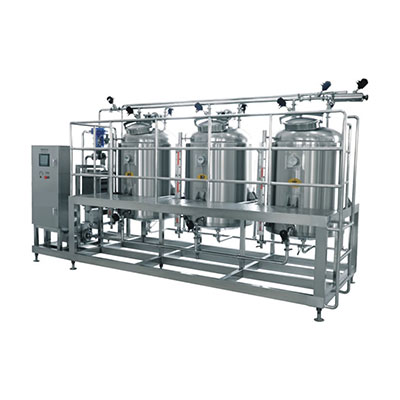
The so-called CIP cleaning system is in-situ cleaning system, that is to say, in the whole cleaning process, local cleaning station equipment and production tanks, pipelines and processing equipment form a closed loop, which can be cleaned without disassembling equipment. CIP cleaning system can ensure certain cleaning effect and improve product safety; save operation time and improve efficiency; save labor force and ensure operation safety; save energy such as water and steam, reduce detergent consumption; production equipment can achieve large-scale, high automation level; prolong the service life of production equipment. The detergent of CIP cleaning system can be selected according to the nature and degree of contamination, material composition, water quality, cleaning method, cost and safety of cleaning objects. Commonly used detergents are acid, alkali detergents and sterile detergents.
The advantages of acid and alkali detergents are that they can kill all microorganisms and remove organic matter effectively.
The disadvantages are: strong irritation to skin; poor washability.
The advantages of the sterilizer are: quick germicidal effect, effective for all microorganisms; generally non-toxic after dilution; not affected by water hardness; forming film on the surface of equipment; easy determination of concentration; easy measurement; removal of odor.
Disadvantages are: special taste; need certain storage conditions; different concentrations of bactericidal effect is different; low temperature is easy to freeze; improper use will produce side effects; mixed with sewage sterilization effect is significantly reduced; easy to contaminate the environment and leave traces when sprinkled.
The acid in acid-base detergent refers to 1%-2% nitric acid solution, and the alkali refers to 1%-3% sodium hydroxide used at 65-80 ~C. Sterilizers are commonly used chlorine fungicides, such as sodium hypochlorite.
Influencing factors of cleaning effect, such as contamination degree of equipment, nature of contaminants and production process of products, are the important reasons for determining cleaning effect. If CIP conditions are not determined according to its characteristics, it is difficult to achieve the desired purpose or cause the high cost of cleaning. At present, there are many kinds of detergents used in food industry, including acid and base, among which sodium hydroxide and nitric acid are the most widely used. Alkali detergents have a good removal effect on high protein contaminants, but have a certain corrosion effect on food rubber gaskets. The acid detergent has better effect on the fouling which can not be removed by alkaline detergent, but it is corrosive to metal. Some corrosion resistants should be added or rinsed with clean water. Cleaner also has surfactants, chelating agents, etc., but only when special needs are used, such as cleaning water with high hardness can use chelating agents to remove metal ions. When the concentration of cleaning agent is increased, the cleaning time can be shortened or the insufficiency of cleaning temperature can be compensated. The higher the concentration of cleaning agent, the higher the cleaning cost will be, and the higher the concentration, the more effective the cleaning effect will not be. Therefore, it is necessary for manufacturers to determine the appropriate concentration according to the actual situation. Generally speaking, the chemical reaction rate increases by 1.5-2.0 times with the increase of temperature by 10 C, and the cleaning speed increases correspondingly, so the cleaning effect is better. Cleaning temperature is generally not less than 60 C. Cleaning time and cleaning time are affected by many factors, such as cleaning agent type, concentration, cleaning temperature, product characteristics, production pipeline layout and equipment design. Cleaning time must be appropriate, too short to effectively remove dirt, too long will waste resources.
CIP Cleaning System Procedure
Taking the beverage industry as an example, the cleaning procedures are as follows:
1. Wash hot water for 3-5 minutes at room temperature or above 60 C; alkali wash for 10-20 minutes, 1%-2% solution, 60 80 C; clean water for 5-10 minutes in the middle, below 60 C; and finally wash for 3-5 minutes, clear water.
2. Wash hot water for 3-5 minutes at room temperature or above 60 C. Wash hot water for 5-10 minutes with alkali, 1%-2% solution, 60-80 C. Wash clean water for 5-10 minutes, under 60 C. Sterilize hot water for 10-20 minutes and above 90 C.
Cleaning flow guaranteeing flow is actually to ensure the flow rate of cleaning fluid during cleaning, thus producing a certain mechanical effect, that is, by improving the turbulence of the fluid to improve the impact force and achieve a certain cleaning effect.
The CIP cleaning system designed by our company can be controlled manually or automatically. Specifications and models are customized according to the scope of cleaning. Welcome to inquire.
- Related information
Anhui Xiangpai Machinery Manufacturing Co., Ltd. Copyright Anhui ICP Prepared 16011478-2 Disclaimer