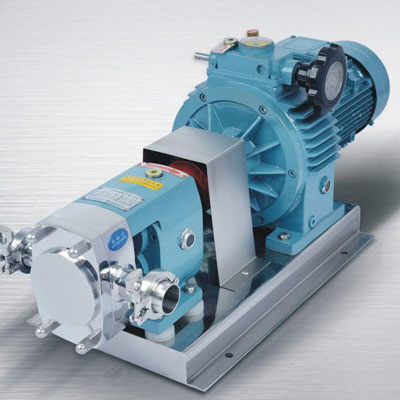
YUY-Z Hygienic Rotor Pump
2019/2/26

Product Description:
Specification: 0.55KW-22KW
Material: SUS304, SUS316L
Speed: 200-900 (rpm)
Product description
Working principle
Rotor pump is also known as colloidal pump, three-leaf pump, sole pump, etc. Relying on two synchronous reverse rotating rotors (teeth number is 2-4), suction (vacuum degree) is generated at the inlet during the rotation process, so as to inhale the material to be transported. The two rotors divide the rotor chamber into several small spaces and operate in a-b-c-d order. When running to position a, only one room is filled with medium; when position b, part of medium is sealed in room B; when position C, medium is also sealed in room A; when position d, room A and room B are connected with two rooms, and the medium is conveyed to the outlet. In this way, the medium (material) is continuously transported out.
Rotor pump transmission: Rotor pump transmission generally has the following forms
1. Motor+constant speed ratio reducer: This kind of transmission mode is simple, the rotor speed is constant, that is to say, the flow rate is not adjustable. If equipped with frequency converter, speed regulation can be achieved.
2. Motor+mechanical friction type CVT: The transmission of this kind of transmission is realized by manual adjustment, which is characterized by safety and reliability, and stepless adjustable flow rate. The disadvantage is non-automatic regulation, which is more troublesome. Speed regulation is carried out in the process of operation. Speed regulation is not allowed in the state of shutdown.
3. Frequency Converter Motor + Frequency Converter: This way can realize the automatic adjustment of speed, that is, the stepless adjustment of flow. Its advantages are high degree of automation and easy operation. The disadvantage is that the price of the converter is higher and the low-speed torque is smaller.
Pump head structure
Rotor pump decomposition diagram
Rotor pump working simulation diagram
Brief Introduction to the Application Scope of Rotor Pump
1. Food and beverage categories: dairy products, latex, chocolate, syrup, cheese, malt juice, beer, soda, butter, concentrated juice, fermentation broth;
2. Fruit concentrate: pudding, jam, jelly, tomato sauce;
3. Paste products: fat and grease, etc.
4, cosmetics: cream, detergent, hair gel, perfume oil and so on;
5. Chemical industry: dyes, fats, solvents, resins and polymers;
6. Drugs: extracts, emulsions, pills, etc.
7. Others: candy industry, baking industry, chemical industry and other fields.
Single leaf rotor
This kind of rotor is specially designed and manufactured to transport materials containing large particles. Its unique shape and curve make it more advantageous than other pumps in conveying materials containing large particles, and can effectively avoid particle damage in the process of conveying.
Double lobe rotor
Rotor pumps with this structure are often used in the transportation of materials containing particles or fillings, and the breakage rate is reduced. This kind of pump usually has a poor convection in the process of conveying materials or has a better effect when the materials contain particles.
Trefoil rotor
The general rotor type has a larger volume than other types of rotors, and various performance indicators are superior to those of one-blade and two-blade rotors.
Multileaf rotor
When the rotor blade is more than three pieces, its volume decreases with the increase of the rotor blade. The more the rotor blade is, the less the volume is. The stability of the multi-blade rotor is relatively improved when conveying materials, but it is easy to break the particulate matter in the conveying process.
Butterfly Rotor Pump
Because butterfly rotor is used, besides the characteristics of general rotor pump, it has certain advantages in conveying materials with high viscosity and larger particles, and can effectively convey especially viscous materials.
Single Butterfly Curve Rotor Pump (Particle Rotor Pump)
This series of pumps is specially designed and manufactured to transport the material containing large particles. Its unique shape and curve form enable it to have incomparable advantages in other pumps when transporting the material containing large particles. In the process of transporting the material, it can effectively avoid particle damage and is the first choice of pumps for transporting the material containing large particles.
Note: The flow range in the table refers to the data measured when the medium is "water".
Speed control adopts stepless transmission or frequency converter, and its speed range is 200-900rpm.
When conveying concentrated liquid with high viscosity, the power of motor must be increased.
For medium with poor fluidity, it is suggested to use a pump with matching flow at the entrance.
If the data in this table are changed, anger will not be notified, and the correct parameters will be based on the substance provided.
Outline size

Anhui Xiangpai Machinery Manufacturing Co., Ltd. Copyright Anhui ICP Prepared 16011478-2 Disclaimer