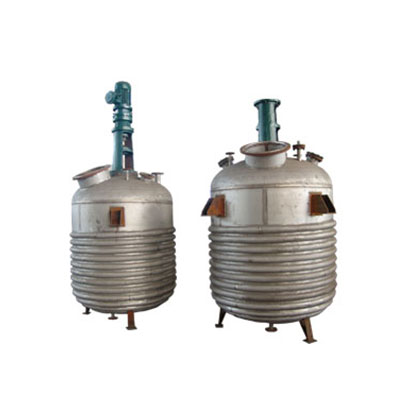
Electric Heating Reactor
2019/2/25

Detailed introduction
I. Overview of Electric Heating Reactor
The electric heating reactor is to heat the heat conducting oil in the jacket with an electric heating rod, so that the heat conducting oil can rapidly rise to the corresponding temperature, and then the temperature control device controls the heat conducting rod to make the power cut off and constant temperature. The temperature control device can also convert the material temperature into electrical signals by the temperature sensor inserted vertically into the tank from the top of the tank, and transmit the temperature control device to the digital display temperature controller on the electric control box through the wire to display the tank. Material temperature, thereby regulating the level of material temperature. As a heating mixing device, the electric heating reactor is especially suitable for small-scale, pilot-scale or large-scale production of non-steam heat source production units and scientific research institutions. It is widely used in light industry such as medicine, chemical industry, fine chemical industry, food additives and so on.
II. Use of Electric Heating Reactor
Electric heating reactor is widely used in petroleum, chemical industry, rubber, pesticide, dyestuff, medicine and food. It is used as pressure vessel for sulfurization, nitration, hydrogenation, alkylation, polymerization and condensation.
3. Structure Composition of Electric Heating Reactor
The structure of the electric heating reactor is composed of a head, a cylinder, a jacket, a heater, a mixer, a mechanical seal, a transmission device and a bracket. Mirror polishing is used on the inner surface of the kettle to ensure no sanitary dead angle. The fully enclosed design ensures that the material is always sterile. Sandblasting, grinding and cold-rolled primary color Matt treatment are optional on the outer surface.
The jacket type of electric heating reactor is divided into jacket type and outer half-pipe type. The jacket oil heating type is equipped with a diversion device, such as heating or cooling coils installed in the kettle body or jacket, and the medium can be put into the coil to complete heating or cooling work.
Electric heating reactor agitator: generally there are paddle type, anchor type, screw type, scraper type, etc., to ensure that the material is evenly harmonized in a short time.
Electric heating reactor drive device: There are ordinary motor, explosion-proof motor, electromagnetic speed regulating motor, frequency converter and so on. Gear reducer should be used when the speed exceeds 160 revolutions.
Axle Seal of Electric Heating Reactor: Seal for common water cooling filler, combined tetrafluoro filler and mechanical seal.
The discharge form of electric heating reactor is divided into ball valve or down-spreading valve.
Installation form of electric heating reaction kettle: Suspension support ear or floor support leg can be used for installation.
Electric heating reactor accessories: sterile respirator, CIP cleaning sprinkler, mirror, flange, sanitary quick opening manhole, etc.
IV. Maintenance of Electric Heating Reactor
1. Maintenance and safety
(1) It should be operated strictly according to the working pressure and temperature on the product nameplate to avoid danger.
(2) Strictly abide by the provisions on cooling, oil injection and other aspects of the product instructions, and do a good job of equipment maintenance and maintenance.
(3) When all valves are used, the stem (needle) should be rotated slowly and the cover should be pressed tightly to achieve sealing effect. When closing, it is not easy to exert too much force to avoid damaging the sealing surface.
(4) Electrical control instruments shall be operated by special persons and overload protection facilities shall be set up according to regulations.
2. Common Fault Phenomena and Reasons Reactor Common Fault Phenomena and Reasons
(1) Fault phenomena: leakage occurs at the sealing surface. Causes of failure: screw thread loosening; sealing surface damage. Removal method: tighten the screw again, grind and polish the sealing surface again.
(2) Fault phenomenon: leakage occurs at the valve. Cause of failure: damage of stem (needle) and sealing surface of valve mouth. Removal methods: Maintenance, replacement of valve stem (needle), valve mouth.
(3) Fault phenomena: the external magnetic steel rotates, the internal magnetic steel does not rotate, and the motor current decreases. Fault reason: the temperature rise in the kettle is too high, the cooling cycle is not smooth, and the internal magnetic steel is demagnetized due to high temperature. In hydrogenation reaction, the inner magnetic steel sleeve has cracks and the inner magnetic steel expands. Exclusion: Notify the supplier and replace the internal magnetic steel.
(4) Fault phenomena: friction noise in magnetic coupling drive. Causes of failure: wear of sleeve and bearing, excessive clearance, internal magnetic steel rotation jump. Exclusion: Contact the supplier and replace the bearing and sleeve.

Anhui Xiangpai Machinery Manufacturing Co., Ltd. Copyright Anhui ICP Prepared 16011478-2 Disclaimer