Percolation tank
2019/2/25

Detailed introduction
The percolation tank is a common equipment for extracting and separating active ingredients in medicine, food and chemical industry. The percolation tank is especially suitable for extracting and extracting active ingredients in medicinal materials. Percolation is a static extraction and exudation method. It is generally used for percolation at room temperature after extraction, and the residue is fully extracted. In the percolation tank, the medicinal materials are often soaked first to accelerate the solvent penetration into the medicinal materials. At the same time, it can prevent the short-circuit phenomenon of the material and liquid during the percolation process, which affects the yield and shortens the extraction time.
The common percolation tanks can be divided into two types: straight cylinder and normal cone. Percolation extraction is a method of leaching the active ingredients in the flowing process by adding leaching solvents to the medicinal materials in the percolation container with high humidity. The leaching solution is called "percolation solution". The common operation modes in the percolation tank can be divided into one-time percolation, heavy percolation (multiple percolation), countercurrent percolation and pressure percolation.
Method of operation:
(1) Wetting: Mix well with the prepared solvent, and the medicinal material will expand fully after absorbing the solvent.
(2) Bucketing: After a period of wetting, the medicinal materials are put into the infiltration bucket. (or multi-functional extraction tank)
(3) Impregnation: Slowly add solvent after filling barrels, up to several centimeters above the surface of the medicine, and put it under cover for 24-48 hours.
(4) Infiltration: After the immersion time is up, the leachate is slowly released and the solvent is added to the powder in time.
Factors Influencing Percolation Quality
(1) Particle size of powder. Excessive extraction is inadequate, and excessive fineness will clog the pore, usually coarse powder (5-20 mesh)
(2) Moisture of powder. Non-wetting easily causes uneven expansion and uneven leaching degree.
(3) The pressure of powder should be uniform.
(4) Controlling the percolation rate, too fast extraction is not enough, too slow affects the efficiency.
2. Structural Characteristics of Percolation Tank
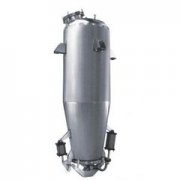
Percolation containers are usually made of wooden barrels, ceramics, copper and stainless steel. In order to ensure the full extraction of medicinal materials by solvent, the length-diameter ratio of the percolation tank is larger, usually 2-4. For the powder with large water solubility, the conical seepage cylinder is better. When the conical cylinder is subjected to the expansion pressure of the powder, the upward force can make a small adjustment of the powder density and uniformity. The percolation tank is usually carried out under normal temperature and pressure, so it is generally single-layer. It can also be heated or cooled according to the design. The slag discharging door can be opened manually and quickly, and the convenient and fast cylinder slag discharging door can also be selected. The cylindrical body can adopt straight cylindrical shape, can adopt regular cone shape, commonly used regular cone shape. The infiltration tank is made of stainless steel, with feeding inlet, liquid inlet, slag discharging door, cleaning outlet and sewage outlet. It is suitable for one-time extraction, multiple extraction, simple operation and full infiltration.
Anhui Xiangpai Machinery Manufacturing Co., Ltd. Copyright Anhui ICP Prepared 16011478-2 Disclaimer