Cryogenic concentrator
2019/2/25

Detailed introduction
I. Summary of cryogenic concentrators:
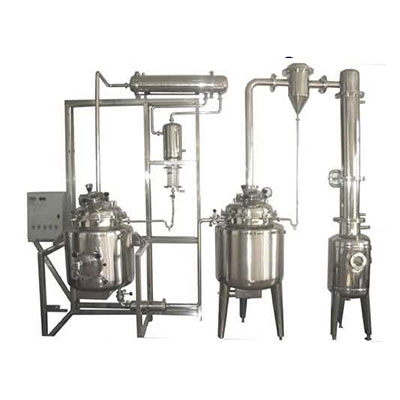
The cryogenic concentrator is suitable for concentrating thermosensitive substances in the fields of Western medicine, traditional Chinese medicine and dairy products. The cryogenic concentrator is an improvement on the basis of the traditional concentrator to reduce the volatilization temperature. Generally, vacuum decompression is used to reduce the boiling point of the material. The common cryogenic concentrators are single-effect external circulation concentrator, double-effect concentrator and vacuum vacuum vacuum concentrator. Each concentrator has its own advantages. All cryogenic concentrators in our company are made of high quality stainless steel. The inner and outer surfaces are polished, smooth and without dead angle, which meets the GMP standard.
2. Structure and characteristics of cryogenic concentrator
The cryogenic concentrator is basically composed of heating chamber or concentrating tank body, evaporation chamber, condenser, cooler, gas-liquid separator, receiving tank and so on. The heating chamber plays the role of heating materials. Generally, materials are connected with the evaporation chamber in the pipeline, and materials circulate. This concentrator is suitable for concentrating materials with thinner concentration. Evaporation chamber is the site for evaporation and concentration of materials. Evaporation chamber is generally set up larger, reserved evaporation space, to prevent foam material evaporation away. The concentrator of concentrator type is heated and evaporated in one tank. The material evaporates in the tank by jacket heating. This kind of general charge can not be too much, and the evaporation space is reserved. The matching of condenser and cooler according to evaporation capacity can not only ensure condensation and cooling effect, but also facilitate cleaning and installation. The receiving tank receives evaporated water or organic solvents. The evaporation liquid can be either recovered or discharged directly. It can be selected according to the need. The whole system is designed and manufactured around the idea of full evaporation of materials, reduction of evaporation temperature of materials, maintenance of material activity, energy saving, environmental protection, easy cleaning, safety and hygiene.
3. Concentrator Design Regulations and National Standards
1. GMP Requirements: To comply with the relevant provisions of SFDA "Drug Production Quality Management Standards (2010 Revision)"
2. Industry Standards
JB/T 20093-2007 Pharmaceutical Machinery Industry Standard
TJ36-79 Design Hygiene Standard for Industrial Enterprises
3. National Standards
General Code for Construction and Acceptance of Mechanical Equipment Installation Engineering GB 50231-2009
"GB 12348-2008 Industrial Enterprise Factory Boundary Noise Standard"
Environmental Protection Law of the People's Republic of China
GB-52261-2002 Mechanical Safety Mechanical and Electrical Equipment Part I: General Technical Conditions
GB-9706.1-1995 General Safety Requirements for Medical Electrical Equipment Part I
GB/T5226.1-96 General Requirements for Electrical Safety Requirements of Mechanical Products
GB/T19910-93 Environmental Requirements and Test Methods for Medical Electrical Equipment
GB150.1-150.4-2011 Steel Pressure Vessels
NB/T47003.1-2009 Steel Welded Atmospheric Pressure Vessel
GAMP Pharmaceutical Production Automation Management Specification
Code for Design of Clean Workshop in Pharmaceutical Industry (GB50457-2008)
4. Terminology commonly used in concentrator design
Abbreviation
Definition
URS
User Requirement Specification
FS
Function Specification
HDS
Hardware Design Specification
SDS
Software Design Specification
DQ
Design Qualification
FAT
Factory Acceptance Testing
SAT
Site Acceptance Testing
IQ
Installation Qualification
OQ
Operation Qualification
PQ
Performance Qualification
EHS
Environmental Health Safety Environmental Health Safety

Anhui Xiangpai Machinery Manufacturing Co., Ltd. Copyright Anhui ICP Prepared 16011478-2 disclaimer