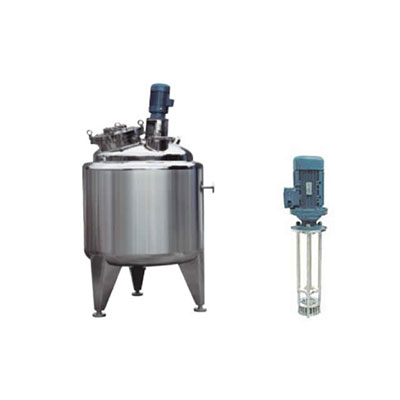
Emulsion tank (high speed emulsification tank)
2019/2/25

Detailed introduction
Summary of Emulsion Tank
The function of the emulsifier is to dissolve one or more materials (water-soluble solid, liquid or colloidal substances, etc.) into another liquid phase and synthesize its water into a relatively stable emulsion. It is widely used for emulsifying and mixing of edible oils, powders, sugars and other raw materials. Emulsifying tanks are also used for emulsifying and dispersing some coatings and paints, especially for some insoluble additives such as CMC and xanthan gum.
II. Applicable Standards for Emulsifying Tanks
Emulsion tank is suitable for the production of cosmetics, medicine, food, chemistry, dyeing, printing ink and other industrial products, especially for the high viscosity of matrix and solid content ratio.
3. The scope of use of emulsifying tanks:
(1) cosmetic products: cream, lotion, lipstick, shampoo, etc.
(2) Pharmaceutical industrial products: ointment, syrup, eye medicine, antibiotics, etc.
(3) Food industrial products: jam, butter, margarine, etc.
(4) Chemical industrial products: chemicals, synthetic adhesives, etc.
(5) Dyeing industrial products: pigments, titanium oxide, etc.
(6) Printing ink: colour ink, resin ink, newspaper ink, etc.
(7) Other: Pigments, waxes, paints, etc.
IV. Structural Characteristics of Emulsion Tanks
The biggest difference between emulsifying tank and reactor, agitating tank, enzymatic hydrolysis tank is the difference in stirring system. Emulsifying tank uses high-speed emulsifying head as stirring system. Its speed is generally 1400 r/min or 2900 r/min. Compared with ordinary reactor, its speed is 0-500 r/min, its speed is high, its efficiency is high, and its stirring form is special. The working principle of the emulsifying head: the centrifugal high-speed emulsifying head can produce a huge rotating suction force when it works. The material above the rotor is rotated and sucked down, then thrown into the stator at high speed. After high-speed shearing, collision and crushing between the rotating stators, the material gathers to the outlet and sprays out. At the same time, the anti-eddy current baffle at the bottom of the tank converts the rotating force into the upside and downward rolling force, so that the material in the tank can be mixed evenly and the powder can be prevented from accumulating on the liquid surface to achieve the purpose of hydration and emulsification. Besides the difference between the mixing system and the reactor, the other configurations are basically the same. The emulsifying tank designed by our company not only uses this kind of high-speed emulsifying head, but also can be matched with frame stirring, scraping stirring and other suitable materials.
V. Advantages of Emulsifying Tanks
Advantages of emulsifying tank Editor Unit adopts upper coaxial three-heavy mixer, hydraulic lifting and opening cover, fast homogeneous mixer speed: 0-3000r/min (variable frequency speed), slow scraper mixer stirring automatically close to tank bottom and tank wall. Vacuum suction is used, especially for powder materials, to avoid dust flying. The whole process is carried out under vacuum conditions to prevent the material from producing bubbles after high-speed stirring, which can meet the requirements of hygiene and sterility. The system is equipped with CIP cleaning system, the contact part between container and material is made of SUS316L material, and the inner surface is mirror polished (sanitary grade).

Anhui Xiangpai Machinery Manufacturing Co., Ltd. Copyright Anhui ICP Prepared 16011478-2 Disclaimer