Thickening equipment
2019/2/25

Detailed introduction
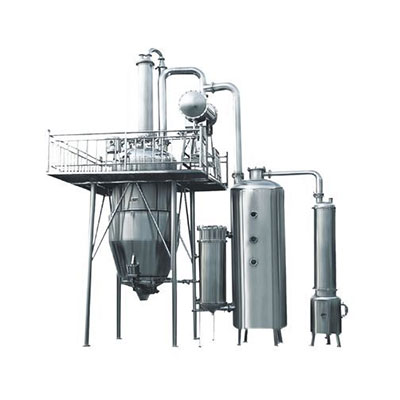
Summary of Concentration Equipment
After extraction and separation, a large number of leaching liquids with lower concentration can not be directly applied, nor is it conducive to the preparation of other formulations. Therefore, small volume concentrates or solid products are often obtained through evaporation and drying processes. Therefore, the concentrating equipment has a wide range of applications. It is suitable for vacuum concentrating and crystallizing of traditional Chinese medicine, oral liquid, food, health care products, etc., as well as the concentrating of ointment, alcohol recovery and other processes.
(1) According to the operating pressure, it can be divided into atmospheric evaporation, pressurized evaporation and vacuum evaporation. Atmospheric pressure evaporation refers to the evaporation operation under atmospheric pressure, the equipment is not necessarily sealed, resulting in the natural exhaust of secondary steam; pressurized evaporation refers to the evaporation operation under a certain pressure, when the equipment is sealed, the pressure above the solution is high, the boiling point of the solution rises, the secondary steam generated can be used as a heat source for reuse. Vacuum evaporation refers to evaporation in vacuum. The negative pressure above the solution decreases the boiling point of the solution, which increases the temperature difference between the heated vapor and the solution and increases the heat transfer rate. It is very suitable for the concentration of the thermosensitive solution. The most widely used is vacuum evaporation.
Common Concentration Equipment
1. Central Circulating Tube Evaporator
The heating chamber is a shell-and-tube heat exchanger. A central circulating tube with a much larger diameter is installed in the center of the heat exchanger. Because of its large diameter, large cross-section area, much smaller heat transfer area per unit volume solution, smaller heat acceptance and relatively lower temperature, the liquid density in the central tube is larger than that in the tube, forming a natural course of liquid rising from each tube and falling from the central tube. Ring. Advantages: simple structure, compact equipment, easy to clean and repair, suitable for materials with high viscosity. Because of its wide application, central circulation tube evaporator is also called standard evaporator.
2. Suspension basket evaporator
The column tubes in the heating chamber are integrated and suspended below the evaporation chamber. The heated steam enters the tube compartment of the heating chamber through a central tube. A large annular gap is formed between the heating chamber and the shell without a thicker central circulating pipe. The liquid circulates upward and downward from the tube to the annulus around it.
Characteristic: The circulation effect is better than the central circulation tube, but the structure is more complex and the price is more expensive. It is suitable for solution which is easy to scale or crystallize.
3. Externally heated evaporator
The heating chamber and evaporation chamber are divided into two parts. After heating, the boiling solution rises from the heating chamber to the evaporation chamber, and the separated liquid part returns to the heating chamber through the circulating tube. Because the liquid in the circulating tube is not heated, the density of the liquid in the circulating tube is much higher than that in the heating chamber, so the circulating rate is accelerated.
With higher heat transfer rate, it can also reduce the height of the whole evaporator and has strong adaptability, but its structure is compact and its thermal efficiency is low.
4. Forced Circulation Evaporator
The liquid flow depends on the external power of the pump. The evaporation rate is high, and the material liquid can circulate well. It is suitable for liquid material with high viscosity, easy to crystallize, foam and dirt.
The disadvantage is increased power equipment and power consumption.
5. One-way evaporator
In pharmaceutical production, some liquid materials will destroy the active ingredients of drugs at higher temperature or for longer heating time, thus reducing the efficacy of drugs. We call this material a heat sensitive material.
For thermal sensitive materials, it is not appropriate to use circulating evaporator (continuous circulating heating). It is necessary to use a kind of evaporation equipment which can meet the requirement of concentration for material heating time to a few seconds. (One-way evaporator): rising film evaporator, falling film evaporator and rotary evaporator.
6. Rising film evaporator
Large evaporation, suitable for concentration of dilute solution, not suitable for evaporation of materials with high viscosity and easy crystallization or scaling
7. Falling film evaporator
Short residence time, suitable for evaporation of heat sensitive materials, also suitable for concentration of high viscosity liquid.
8. Rotary thin film evaporator
It is suitable for heat sensitive materials with easy crystallization, scaling and high viscosity, but it has high processing accuracy, large power consumption, small heat transfer area and small evaporation.
Anhui Xiangpai Machinery Manufacturing Co., Ltd. Copyright Anhui ICP Prepared 16011478-2 Disclaimer