Liquid distribution tank
2019/2/25

Detailed introduction
I. Overview of liquid dispensing tanks
1. The mixing tank, also known as the mixing tank, mixing tank, mixing tank, is a stainless steel mixing mixing vessel which mixes one or several materials according to the technological proportions. It is suitable for the preparation and storage of liquid materials in traditional Chinese medicine, food and chemical industry. Steam or cold water can be introduced into the jacket to keep the materials at suitable temperature. It is an injection, large infusion, concentrated and dilute mixing of liquid medicine. Preferred equipment.
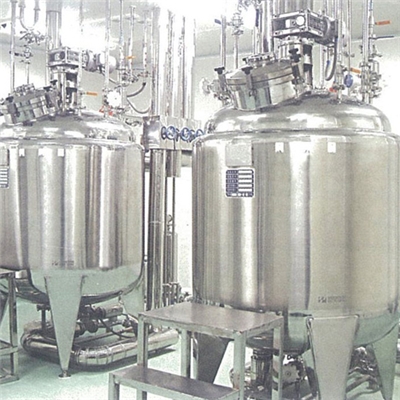
There are many kinds of liquid dispensing tanks and their names. The common ones are stainless steel liquid dispensing tanks, magnetic stirring liquid dispensing tanks, heat preservation liquid dispensing tanks, buffer liquid dispensing tanks, sterile liquid dispensing tanks, single-layer liquid dispensing tanks, etc. Distribution tank is generally a fully sealed, vertical structure of sanitary and clean containers, with heating, cooling, heat preservation, stirring and other functions. The tank with heating or cooling function is provided with a jacket, which can be heated or cooled by heating or cooling medium respectively, so that the medicinal liquid can be fully dissolved and dispensed by the operation of the agitator. The main configurations of liquid distribution tank system are transmission device, mechanical seal device, temperature control device, spotlight, sight mirror, mixing device, manhole feeding and opening device, steam inlet, condensate outlet, material outlet, sewage outlet, sampling port, 360 degree universal cleaning ball, and some are orifice plate filter device, weighing and measuring device, liquid level measuring device, circulation device, etc. According to the requirements of process characteristics, there are single-layer liquid distribution tank, double-layer heat preservation liquid distribution tank and three-layer heat exchange heat preservation liquid distribution tank.
2. Structural Characteristics of Stainless Steel Liquid Distribution Tank
1. Hygienic aseptic design is adopted for the tank body of liquid distribution tank. Drawing treatment is adopted for each pipe orifice to form a smooth transition, avoiding the cleaning dead angle caused by direct socket welding and ensuring the reliability and stability of the production process. Mirror polishing treatment for inner tank surface (roughness Ra < 0.4? M); mirror panel or grinding plate for outer surface, which is hygienic and beautiful.
2. The process interfaces all adopt ISO standard quick-loading chuck-type interfaces, which are sanitary, no dead angle, easy to disassemble and equipped with anti-corrosion gaskets. Guarantee service life.
3. It has on-line cleaning (CIP) and on-line sterilization (SIP) functions and meets GMP standards.
4. Mechanical stirring or magnetic stirring can be used. Pulp blade or impeller type or anchor type are often used in the form of stirring. Which kind of stirring should be chosen according to the material characteristics.
5. The inner surface is treated as mirror, and the outer surface is subglossy or the upper and lower head is subglossy. It is easy to clean without leaving dead angle.
6. Heating jacket can be full-jacket or half-pipe or honeycomb. According to material characteristics and heat transfer requirements, jacket form is designed to ensure heat transfer effect and save cost.
7. Temperature display control system and liquid level display system can be selected according to need. For those with remote output control functions required for automation, local display and manual control are used for routine operation observation.
8. Drawing flanging process is adopted for arc transition of pipe orifice, which is smooth and easy to clean without dead angle, ensuring the reliability, stability of production process and meeting the requirements of GMP.
9. Equipment seal adopts special sanitary mechanical seal, which is wear-resistant, non-polluting material and has good sealing performance.
II. Overview of Concentration Tank
1. Concentration tank is a kind of tank for liquid preparation and storage in pharmaceutical industry. It is a generic name in pharmaceutical industry and a kind of tank for liquid distribution. The difference between concentrated tank and dilute tank is that the concentration of liquid is different. Concentration is diluted and then made up. The tank for preparing high concentration liquid is called concentrating tank, and the tank for preparing low concentration liquid is called diluting tank. Used in different industries called different, used in the preparation of food storage tanks, we call the preparation tank or dispensing tank, and some also called the configuration tank or mixing tank. Used in chemical industry to prepare storage tanks, we call them mixing cylinders or batching barrels. Concentrated dispensing tank is suitable for the preparation and storage of liquid materials in traditional Chinese medicine, food and chemical industries. Steam or cold water can be introduced into the jacket to keep the materials at suitable temperature. It is the preferred equipment for the concentration and dilution of injections, large infusions and medicinal liquids.
Concentration tank is generally a fully sealed, vertical structure of sanitary and clean container, with heating, cooling, heat preservation, stirring and other functions. A jacket is arranged in the tank body of the concentration tank with heating or cooling function, which can be heated or cooled by heating or cooling medium respectively, so that the medicine liquid can be fully dissolved and dispensed by means of the operation of the agitator. The main configurations of dense distribution tank system are transmission device, mechanical seal device, temperature control device, spotlight, sight mirror, mixing device, manhole feeding and opening device, steam inlet, condensate outlet, material outlet, sewage outlet, sampling port, 360 degree universal cleaning ball, and some are orifice plate filter device, weighing metering device, liquid level metering device, circulation device, etc. According to the requirements of process characteristics, there are single-layer, double-layer and three-layer heat exchanger.
2. Structural characteristics of concentrated tank:
1. The tank body of concentrated distribution tank is designed with sanitary aseptic grade, and the pipe orifices are drawn to form a smooth transition, avoiding the cleaning dead angle caused by direct socket welding and ensuring the reliability and stability of the production process. Mirror polishing treatment for inner tank surface (roughness Ra < 0.4? M); mirror panel or grinding plate for outer surface, which is hygienic and beautiful.
2. The process interfaces all adopt ISO standard quick-loading chuck-type interfaces, which are sanitary, no dead angle, easy to disassemble and equipped with anti-corrosion gaskets. Guarantee service life.
3. It has on-line cleaning (CIP) and on-line sterilization (SIP) functions and meets GMP standards.
4. Mechanical stirring or magnetic stirring can be used. Pulp blade or impeller type or anchor type are often used in the form of stirring. Which kind of stirring should be chosen according to the material characteristics.
5. The inner surface is treated as mirror, and the outer surface is subglossy or the upper and lower head is subglossy. It is easy to clean without leaving dead angle.
6. Heating jacket can be full-jacket or half-pipe or honeycomb. According to material characteristics and heat transfer requirements, jacket form is designed to ensure heat transfer effect and save cost.
7. Temperature display control system and liquid level display system can be selected according to need. For those with remote output control functions required for automation, local display and manual control are used for routine operation observation.
8. Drawing flanging process is adopted for arc transition of pipe orifice, which is smooth and easy to clean without dead angle, ensuring the reliability, stability of production process and meeting the requirements of GMP.
9. Equipment seal adopts special sanitary mechanical seal, which is wear-resistant, non-polluting material and has good sealing performance.
3. Sparse Distribution Tank
1. Overview of the dilute tank. The dilute tank is used for concentrated/dilute liquid distribution in the pharmaceutical industry. The jacket is arranged in the tank body, which can be heated, cooled and kept at constant temperature. Compared with the concentrated tank, the stirring power of the dilute tank is smaller than that of the same type. Sparse distribution tanks are generally fully sealed, vertical structure of sanitary and clean containers, with heating, cooling, heat preservation, mixing and other functions. A jacket is arranged in the tank body of the dilute distribution tank with heating or cooling function, which can be heated or cooled by heating or cooling medium respectively, so that the medicine liquid can be fully dissolved and dispensed by means of the operation of the agitator. The main configurations of the sparse distribution tank system are transmission device, mechanical seal device, temperature control device, spotlight, sight mirror, mixing device, manhole feeding and opening device, steam inlet, condensate outlet, material outlet, sewage outlet, sampling port, 360 degree universal cleaning ball, and some are orifice plate filter device, weighing and metering device, liquid level metering device, circulation device, etc. According to the requirements of process characteristics, there are single-layer, double-layer and three-layer heat exchanger.
2. Structural characteristics of dilute tank:
1. The tank body of dilute distribution tank is designed with sanitary aseptic grade, and the pipe orifices are drawn to form a smooth transition, avoiding the cleaning dead angle caused by direct socket welding and ensuring the reliability and stability of the production process. Mirror polishing treatment for inner tank surface (roughness Ra < 0.4? M); mirror panel or grinding plate for outer surface, which is hygienic and beautiful.
2. The process interfaces all adopt ISO standard quick-loading chuck-type interfaces, which are sanitary, no dead angle, easy to disassemble and equipped with anti-corrosion gaskets. Guarantee service life.
3. It has on-line cleaning (CIP) and on-line sterilization (SIP) functions and meets GMP standards.
4. Mechanical stirring or magnetic stirring can be used. Pulp blade or impeller type or anchor type are often used in the form of stirring. Which kind of stirring should be chosen according to the material characteristics.
5. The inner surface is treated as mirror, and the outer surface is subglossy or the upper and lower head is subglossy. It is easy to clean without leaving dead angle.
6. Heating jacket can be full-jacket or half-pipe or honeycomb. According to material characteristics and heat transfer requirements, jacket form is designed to ensure heat transfer effect and save cost.
7. Temperature display control system and liquid level display system can be selected according to need. For those with remote output control functions required for automation, local display and manual control are used for routine operation observation.
8. Drawing flanging process is adopted for arc transition of pipe orifice, which is smooth and easy to clean without dead angle, ensuring the reliability, stability of production process and meeting the requirements of GMP.
9. Equipment seal adopts special sanitary mechanical seal, which is wear-resistant, non-polluting material and has good sealing performance.
四、稀配罐、浓配罐参照对比关系 4. Comparison of Reference Relations between Rare and Concentrated Distribution Tanks
1. Definition of dilute tank and concentrated tank:
The dilute mixing tank and the concentrated mixing tank are mixing mixing mixing vessels of one or several materials according to the technological proportions. Concentration tank is opposite to dilute tank. Its function is the same. The process is slightly different, and the parameters of equipment are slightly different.
2. The application of dilute tank and concentrated tank:
Rare and concentrated cans are mainly used in dairy, food, beverage, pharmaceutical, pharmaceutical and other industries. They are most widely used in pharmaceutical and dairy industries.
3. Overview of dilute and concentrated mixing tanks:
The design of the rare and concentrated tank produced by Beijing Rena is reasonable and the process is advanced, which fully meets the requirements of the national GMP certification. Vertical structure is often used in the tank body of dilute and concentrated tank, and the inner liner is polished precisely. The inner cylinder of the sparse tank and the concentrated tank is stirred with frame, anchor, propeller and blade type, and the outer insulation is filled with polyurethane material. The exterior is insulated by mirror panel or grinding plate, and the gloss of the tank body is the same. The dilute and concentrated dispensing tanks are made of 316L, while the others are made of 304. The bottom head of the inner tank body is an elliptical one, and the top of the tank body is provided with inlet opening, reflux opening, disinfection opening, cleaning ball, manhole, breathing opening (0.22um air respirator) and mixing system. The bottom of the tank body is provided with condensate outlet, discharge outlet, sewage outlet, sampling port, temperature probe and liquid level sensor.
4. Functions of dilute and concentrated mixing tanks:
The dilute tank and the concentrated tank have the functions of heating, cooling, heat preservation and stirring. The tank body is designed with process nozzles such as material inlet, pure water outlet, outlet and sampling port, which can provide the conditions of the liquid distribution process. The direct steam can be turned on to achieve sterilization and disinfection function after the liquid mixing is finished. At the same time, after the process of high temperature liquid mixing is completed, the discharging valve can be opened after cooling. In addition, pharmaceuticals dilute matching pot and concentrated matching pot generally have sterilization function.
5. Standards for manufacturing and acceptance of dilute and concentrated tanks:
"Steel Pressure Vessels" GB150-2011, HG20584 "Technical Requirements for Manufacturing Steel Chemical Vessels", HG20583 "Structural Design Regulations for Steel Chemical Vessels", HG/T20569 "Mechanical Mixing Equipment", the current EU drug production quality management standards, customer requirements, SFDA "Quality Management Standards for Pharmaceutical Production" 2010 edition, ISO 14644-1, and "Clean Factory Setting up in Pharmaceutical Industry" Accounting Specification (GB50457-2008), GAMP Pharmaceutical Production Automation Management Specification
Anhui Xiangpai Machinery Manufacturing Co., Ltd. Copyright Anhui ICP Prepared 16011478-2 Disclaimer